
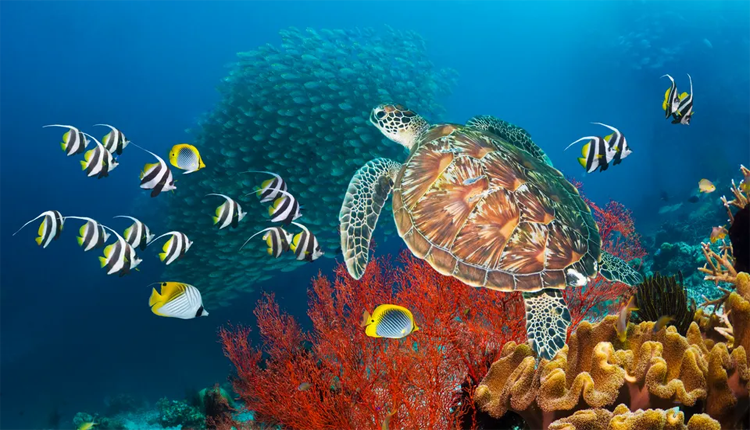
Coral reefs, often celebrated as the “rainforests of the sea,” thrive only under very specific environmental conditions. These fragile ecosystems demand warm, sun-lit, tropical waters with little sedimentation and stable salinity levels. Because of this narrow ecological preference, the planet’s coral reefs are not spread evenly across the world. Instead, they cluster densely within a narrow equatorial zone—particularly the Central Indo-Pacific region, which offers the perfect blend of temperature, depth, and marine biodiversity.
More than two decades ago, the United Nations Environment Programme (UNEP) conducted a comprehensive survey using satellite-based mapping techniques to understand exactly where these reefs were concentrated. Although the research dates back to 2001 and coral ecosystems have since undergone significant stress from rising sea temperatures, mass bleaching events, ocean acidification, and destructive human activity, the dataset still offers valuable insight into the distribution of the world’s largest coral reef systems. It remains a useful benchmark for understanding which countries are custodians of the largest portions of this critical marine habitat.
At the top of the list stands Indonesia, a sprawling archipelago of more than 17,000 islands that sits right in the heart of the Coral Triangle—an area considered the global epicenter of marine biodiversity. Closely following is Australia, home to the legendary Great Barrier Reef, the single largest coral system on Earth. The Philippines, another Coral Triangle nation, holds the third spot with its extensive fringing, barrier, and atoll reefs spread across thousands of islands.
Interestingly, the top ten list also includes countries one might not immediately associate with vast coral formations. Nations such as France, which holds numerous overseas territories, and the Marshall Islands, a small Pacific nation made entirely of atolls, rank remarkably high due to their unique geographic features. Meanwhile, India, which is typically known more for its vast landmass than its marine resources, also secures a position on the list. With reef systems stretching across the Andaman and Nicobar Islands, Lakshadweep, the Gulf of Mannar, and parts of the Gulf of Kutch, India claims the tenth-largest coral reef area in the world—approximately 5,790 sq km.
Below is an expanded narrative of the countries identified by the UNEP study as holding the world’s largest coral reef areas, explaining why each nation occupies such a significant position in global reef geography.
Indonesia – 51,020 sq km
Indonesia’s unmatched coral reef area comes from its strategic placement across the world’s most biologically rich marine corridor. Sitting at the crossroads of the Indian and Pacific Oceans, Indonesia’s waters host more than 500 coral species and support one of the richest marine ecosystems on the planet. Its reefs include fringing reefs, patch reefs, barrier systems, and spectacular deep-water coral formations. From Raja Ampat to the Banda Sea, the region’s biodiversity is unparalleled.
Australia – 48,960 sq km
Australia’s coral wealth is dominated by the Great Barrier Reef, stretching over 2,300 kilometers along the Queensland coast. This iconic reef system is so vast that it is visible from space. Beyond the Great Barrier Reef, Australia also harbors significant reef structures in Western Australia, including the Ningaloo Reef. Despite facing severe bleaching over the past decade, Australia remains a global symbol of coral conservation and marine science.
The Philippines – 25,060 sq km
The Philippines is another titan of marine biodiversity with more than 7,600 islands surrounded by rich coral ecosystems. Its reefs support approximately 500 coral species and thousands of marine species. Unfortunately, they have been historically vulnerable to destructive fishing practices and climate stress, making conservation efforts increasingly critical.
France – 14,280 sq km
France earns its place not through its European coastline but through overseas territories such as French Polynesia, New Caledonia, Mayotte, and Réunion. These tropical territories contain massive barrier and atoll reef systems, many of which are globally important for biodiversity and tourism.
Papua New Guinea – 13,840 sq km
Papua New Guinea lies adjacent to Indonesia and the Coral Triangle, giving it access to some of the richest coral habitats anywhere. Much of its reef territory remains relatively unexplored, offering significant potential for scientific discovery.
Fiji – 10,020 sq km
Fiji’s reefs, famous for their soft corals, surround the archipelago in a vibrant halo. These reefs play an essential role in the country’s economy, particularly tourism and fisheries.
Maldives – 8,920 sq km
A nation composed almost entirely of coral atolls, the Maldives boasts extensive reef formations that protect its islands from erosion and amplify its reputation as a premier diving destination.
Saudi Arabia – 6,660 sq km
Saudi Arabia’s coral reefs lie primarily along the Red Sea, a region known for its remarkable resilience to warming waters. Scientists often study these reefs to understand how coral ecosystems can adapt to climate stress.
Marshall Islands – 6,110 sq km
The Marshall Islands, consisting of low-lying atolls, contains some of the world’s most pristine coral ecosystems. The reefs form an integral part of the nation’s structure and survival.
India – 5,790 sq km
From the pristine reefs of the Andaman Sea to the circular atolls of Lakshadweep, India’s coral systems are ecologically diverse and culturally significant. While they face challenges from warming waters, pollution, and coastal development, they remain vital to India’s marine biodiversity.
These rankings highlight not only where reefs are located, but also which nations bear the greatest responsibility for protecting these irreplaceable underwater ecosystems. As climate change continues to reshape the world’s oceans, the stewardship of these reef-rich countries becomes increasingly crucial for global ecological stability.


