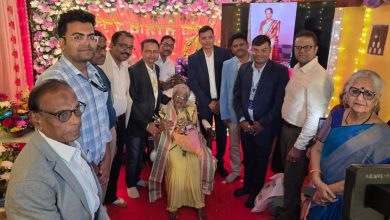

New Delhi : Prof. Kishor Basa, Chairman of the National Monuments Authority, Government of India, along with his twin brother Er. Ashok Basa, Chair of the Strategic Planning Committee of the World Federation of Engineering Organizations (WFEO), former Executive Vice President of WFEO, and former President of The Institution of Engineers (India), met the Hon’ble President of India, Smt. Droupadi Murmu on the afternoon of 18 November.
During the interaction, Prof. Kishor Basa shared significant concerns and recommendations aimed at strengthening cultural preservation and tribal welfare in Odisha. He proposed the establishment of a National Institute of Tribal Development (NITD) at Rairangpur, Mayurbhanj, under the Ministry of Tribal Affairs. He highlighted Rairangpur’s strategic location, surrounded by a dense tribal population from Odisha as well as bordering regions of Jharkhand and West Bengal. He suggested that the proposed institute could be developed on the lines of the National Institute of Rural Development (NIRD), Hyderabad.

Prof. Basa also emphasized the cultural value of Jhumar, an important intangible traditional performing art reflecting socio-cultural unity among communities across Odisha, Chhattisgarh, Jharkhand, West Bengal, and Assam. To preserve and promote this rich heritage form, he proposed establishing a National Centre for Jhumar at Baripada, Mayurbhanj, under the Ministry of Culture. In addition, he recommended bringing the nationally acclaimed Khiching Archaeological Museum—presently under the Odisha State Government—under the Archaeological Survey of India (ASI) for enhanced conservation, exhibition, and research.
Er. Ashok Basa drew the Hon’ble President’s attention to the growing global water crisis, citing the United Nations’ launch of the “Water Action Decade 2018–2028” and the direct linkage of water sustainability with SDGs 6, 11, 13, and 14. He underlined that India is currently confronting one of the most severe water shortages in its history, which could lead to a potential 6% reduction in GDP by 2050, and by 2030, the national water demand is expected to surpass availability, resulting in acute scarcity.

In light of this alarming scenario, he stressed the need for robust governance and integrated water resource management. He proposed the launch of a pilot initiative in Odisha by creating a State Water Management Authority to restructure water policies and implement sustainable, scientific, and coordinated water management procedures. A detailed project note was handed over during the meeting.
Both Prof. Basa and Er. Basa expressed deep gratitude to the Hon’ble President of India, Smt. Droupadi Murmu for her valuable time and for allowing them to present their ideas for the nation’s long-term benefit.