
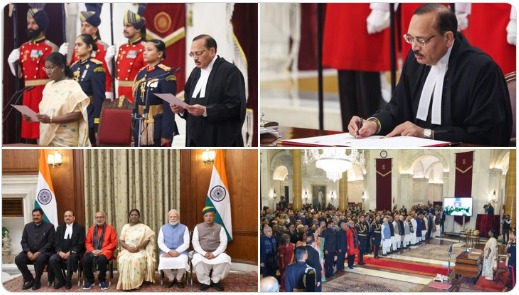
New Delhi: Justice Surya Kant was formally sworn in as the 53rd Chief Justice of India (CJI) on Monday, with President Droupadi Murmu administering the oath at a ceremony held at Rashtrapati Bhavan in New Delhi. In a notable deviation from recent tradition, Justice Kant delivered his oath in Hindi and invoked the name of God, marking a symbolic moment in the ceremony.
The event witnessed the attendance of several eminent dignitaries, including Prime Minister Narendra Modi, Vice President C.P. Radhakrishnan, Union ministers, Haryana Chief Minister Naib Singh Saini, senior judges of the Supreme Court, and Chief Justices and judges from nations such as Bhutan, Kenya, Malaysia, Brazil, Mauritius, Nepal, and Sri Lanka.
Justice Kant will serve as the country’s highest judicial authority for nearly 14 months, with his tenure slated to conclude on February 9, 2027. His appointment came after the Union government approved the recommendation of outgoing CJI Bhushan R. Gavai on October 30. The Ministry of Law and Justice later issued a notification under Article 124(2) of the Constitution, confirming Justice Kant’s elevation effective November 24, 2025.
Born on February 10, 1962, in a modest household in Haryana, Surya Kant pursued his graduation from Government Post Graduate College in Hisar in 1981 before completing his law degree from Maharishi Dayanand University, Rohtak, in 1984. He began practising law the same year in Hisar and moved to Chandigarh in 1985 to take up practice at the Punjab and Haryana High Court. His legal career included handling a wide range of constitutional, service, and civil matters, and he represented numerous institutions such as universities, Boards, corporations, banks, and even the High Court itself.
On July 7, 2000, he became the youngest Advocate General of Haryana and was designated a senior advocate in March 2001. He was elevated as a permanent judge of the Punjab and Haryana High Court on January 9, 2004. Justice Kant went on to serve as the Chief Justice of the Himachal Pradesh High Court from October 5, 2018, before being appointed to the Supreme Court on May 24, 2019.
Throughout his judicial career, he has been actively associated with various legal bodies. He served two consecutive terms (2007–2011) on the Governing Body of the National Legal Services Authority (NALSA) and continues to contribute to several committees of the Indian Law Institute. Since November 2024, he has also been serving as the Chairman of the Supreme Court Legal Services Committee.